
Stop Being Dragged. Start Dancing: The Science and Soul of Adapting to Change
Mar 25, 2026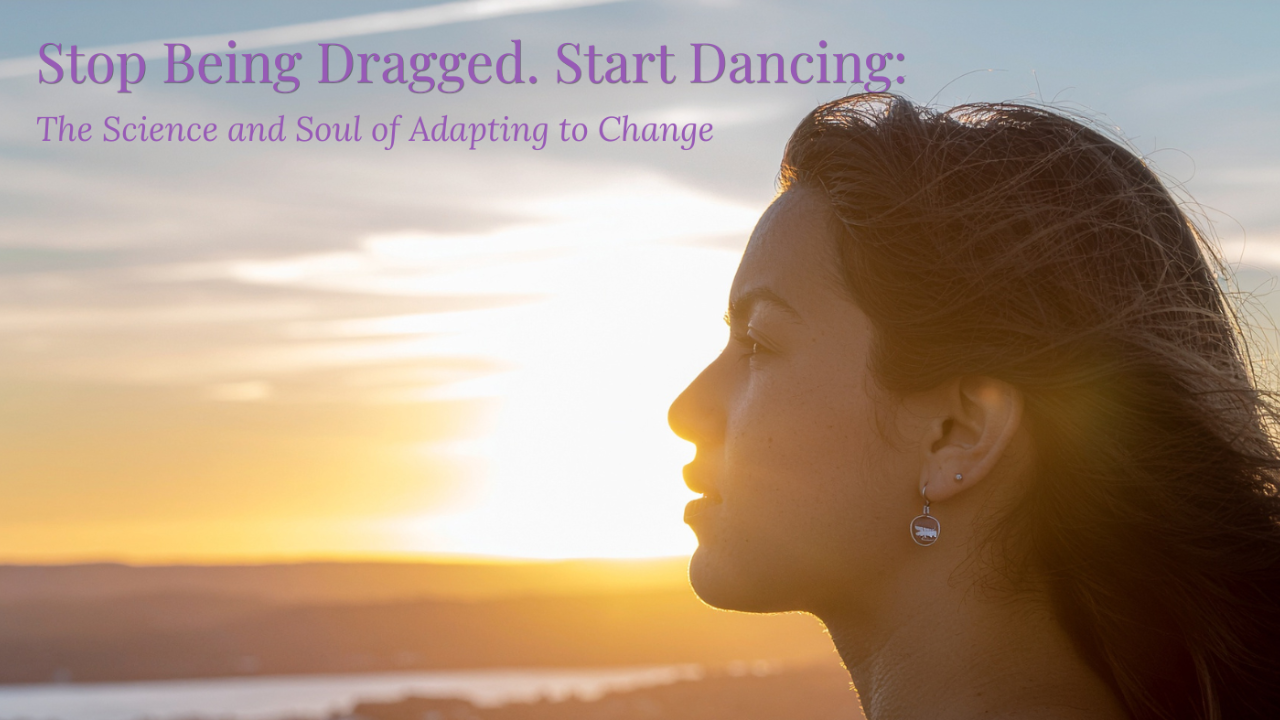
Let’s get real for a second.
Change is not the problem. Your resistance to change is the problem.
I know that’s a bold thing to say. But I’ve spent decades studying the intersection of human sexuality, multicultural identity, and personal transformation, and here’s what I keep seeing: we spend enormous energy fighting the very tides that are trying to carry us forward. We grip. We brace. We white-knuckle our way through seasons of life that are begging us to grow. And then we wonder why we feel like we’re constantly being dragged.
What if I told you that the drag isn’t the change itself — it’s the resistance? And more importantly, what if the science agrees with me?
This week on my Facebook Monday Morning LIVE, we were talking about adaptation: what it really means, why our brains make it so hard, and what it looks like to become the woman who can hold more, feel more, and live more fully turned on to her life.
Your Brain Isn’t Broken. It’s Just Wired for Yesterday.
Let’s start with a little grace. If you struggle with change, you are not weak, stubborn, or damaged. You are deeply, exquisitely human. Neuroscience tells us that when our brain perceives change, it often processes it as an error or a threat. The amygdala — the brain’s fear center — activates, pulling resources away from the prefrontal cortex, which is responsible for logic and long-term reasoning (Science of People, 2025). In plain language: change literally makes it harder to think clearly, at first.
Research also points to something called loss aversion bias, first documented by psychologists Daniel Kahneman and Amos Tversky. Their foundational work showed that people perceive potential losses as significantly more psychologically impactful than equivalent gains (Neurofied, 2026). When your body shifts, your relationship changes, your desire evolves — your brain doesn’t automatically read that as growth. It reads it as loss. And loss feels dangerous.
There is also what researchers call status quo bias — a documented tendency to prefer things to stay the same, even when the alternative offers clear advantages. Studies at Stanford University found that participants consistently chose familiar options over objectively better alternatives, simply because the familiar felt safe (Medium, 2024). We are literally wired to prefer yesterday over tomorrow.
But here’s the thing, love: being wired for something doesn’t mean you’re sentenced to it.
Resistance Has a Grief Cycle. Give It Its Due.
One thing the research confirms that I’ve witnessed in my community work again and again: resisting unwelcome change can mirror the grief process. Researchers Constantinescu and Alexandrache (2014) found that coping with significant change can, in many respects, resemble the experience of losing a loved one (EBSCO Research Starters). There is a denial, a bargaining, a depression — and finally, if we allow it, an acceptance that opens the door to something new.
What this means for you is that if you’re in a season of transition — a body that doesn’t look the way it used to, a relationship that has evolved past what you knew, a desire that is pulling you somewhere unfamiliar — you are allowed to grieve the version of yourself that came before. That’s not weakness. That’s wisdom. The mistake isn’t in feeling the loss. The mistake is in staying there.
The Women Who Thrive Are Flexible, Not Fearless
Let me be clear: the goal is not to become someone who never feels fear. The goal is to become someone whose flexibility is greater than her fear.
Research on psychological flexibility — defined broadly as the ability to accept difficult thoughts and feelings without judgment and take action in accordance with your values — consistently shows it is one of the strongest predictors of resilience and wellbeing. A longitudinal study published in Scientific Reports found that psychological flexibility was a key factor in predicting resilient mental health trajectories under extreme stress (Pellerin et al., 2022). During the pandemic, higher psychological flexibility was directly linked to lower anxiety and depression (Psych Today, 2025). Students with greater adaptability reported 40% fewer depressive symptoms over a university year compared to their less flexible peers (Lee & Park, 2022, as cited in Psychology Today, 2025).
And specifically for women: a study published in Psychophysiology found that high-resilience women demonstrated significantly better cognitive flexibility — the neuropsychological ability to adapt behavior to changing demands — compared to low-resilience women (Garrido et al., 2020). Resilience, in short, is not a personality trait you’re born with. It’s a capacity you practice. And psychological flexibility is the muscle that makes it possible.
Flexibility, as researchers Bonanno and Burton (2013) describe it, is the capacity to read a situation accurately, draw on diverse coping strategies, and fine-tune your response based on real-time feedback. It is not passivity. It is not surrender. It is sophisticated, strategic power.
Curiosity Is the Antidote to Fear
So what does it look like to stop resisting and start adapting? It starts with one question: “What is this inviting me into?”
The Harvard Business Review’s research on curiosity found that curious individuals think more deeply and rationally about decisions, generate more creative solutions, and display less defensive reactions to stress (as cited in Moms Making Six Figures, 2021). In other words, curiosity doesn’t just feel better — it literally produces better outcomes. When you approach an uncomfortable change with curiosity instead of fear, you rewire your relationship to uncertainty itself.
And here is what I love most about the science here: curiosity is not fixed. A 2025 study out of UC Santa Barbara found that even a three-week intentional curiosity practice produced significant increases in trait-level curiosity, along with reduced boredom, greater creative engagement, and a stronger sense of meaning in life (UCSB, 2025). Your personality is not your prison. Your openness is something you can grow.
The growth mindset research of Carol Dweck and colleagues tells us the same thing from a different angle: approaching challenges as opportunities for development rather than threats to self-worth creates both better outcomes and greater resilience (Employee and Family Resources, 2022). Reframing is not toxic positivity. Reframing is neuroscience in action.
This Is an Invitation, Not an Attack
I want you to sit with this:
What if change isn’t happening to you? What if it’s happening for you?
What if this uncomfortable, uncertain version of your life is actually an invitation to become the woman who can hold more, feel more, desire more, and live more fully turned on to her life? Not because the discomfort is fun — it isn’t. But because every season that stretches you is a season that expands your capacity.
The Resilience Institute describes it this way: real strength lies in switching strategies to meet changing demands, not in mastering just one technique (Bonanno & Burton, 2013, as cited in Psychology Today, 2025). The women who thrive aren’t the ones who avoid change. They’re the ones who learn to dance with it.
Your Invitation to Rise
Not perfection. Not control. Adaptation.
Ask yourself these questions — in your journal, in your mirror, or in quiet conversation with yourself:
- Where am I resisting instead of rising?
- What would it look like to meet this moment with curiosity instead of fear?
- What version of me is being summoned by this change?
- What would I do differently if I trusted this season instead of fighting it?
You don’t have to have it all figured out. You just have to be willing to stop white-knuckling the shore and let the current carry you somewhere new.
Go take on this season. Do it awake, aware, and a little braver than before.
References & Research Citations
Bonanno, G. A., & Burton, C. L. (2013). Regulatory flexibility: An individual differences perspective on coping and emotion regulation. Perspectives on Psychological Science, 8(6), 591–612.
Employee and Family Resources. (2022). The power of mindset: 8 ways to cultivate a growth mindset. https://efr.org
Garrido, A., Duschek, S., Arbol, J. R., Usera, I. G., Vila, J., & Mata, J. L. (2020). Cardiac defense reactivity and cognitive flexibility in high- and low-resilience women. Psychophysiology, 57, e13656.
Kahneman, D., & Tversky, A. (1979). Prospect theory: An analysis of decision under risk. Econometrica, 47(2), 263–291.
Neurofied. (2026, January 23). The psychology of resistance to change in organizations. https://neurofied.com
Pellerin, N., Raufaste, É., & Aguerre, C. (2022). Psychological resources and flexibility predict resilient mental health trajectories during the French COVID-19 lockdown. Scientific Reports, 12, 10665.
Psychology Today. (2025, May 13). The art of flexibility, resilience, and adaptability. https://psychologytoday.com
Research Starters: Resistance to Change. EBSCO. (citing Constantinescu & Alexandrache, 2014). https://www.ebsco.com
Science of People. (2025, December). Resistance to change: 7 types and how to deal with them. https://www.scienceofpeople.com
UC Santa Barbara. (2025). How to become a more curious person, according to new research. https://news.ucsb.edu
Villanova University. (2025). From resistance to embrace: How understanding change psychology transforms organizations. https://www1.villanova.edu
Moms Making Six Figures. (2021). Curiosity is queen to establishing a growth mindset (citing Harvard Business Review, “Why Curiosity Matters”). https://www.momsmakingsixfigures.com
Enjoying the blog? Check out the Rhythm of Life Coaching Skool to find others who are also interested in similar topics, meeting monthly, and working to live their magic.
Stay connected with news and updates!
Join our mailing list to receive the latest news and updates from our team.
Don't worry, your information will not be shared.
We hate SPAM. We will never sell your information, for any reason.